Paisleys, florals and fabric sense
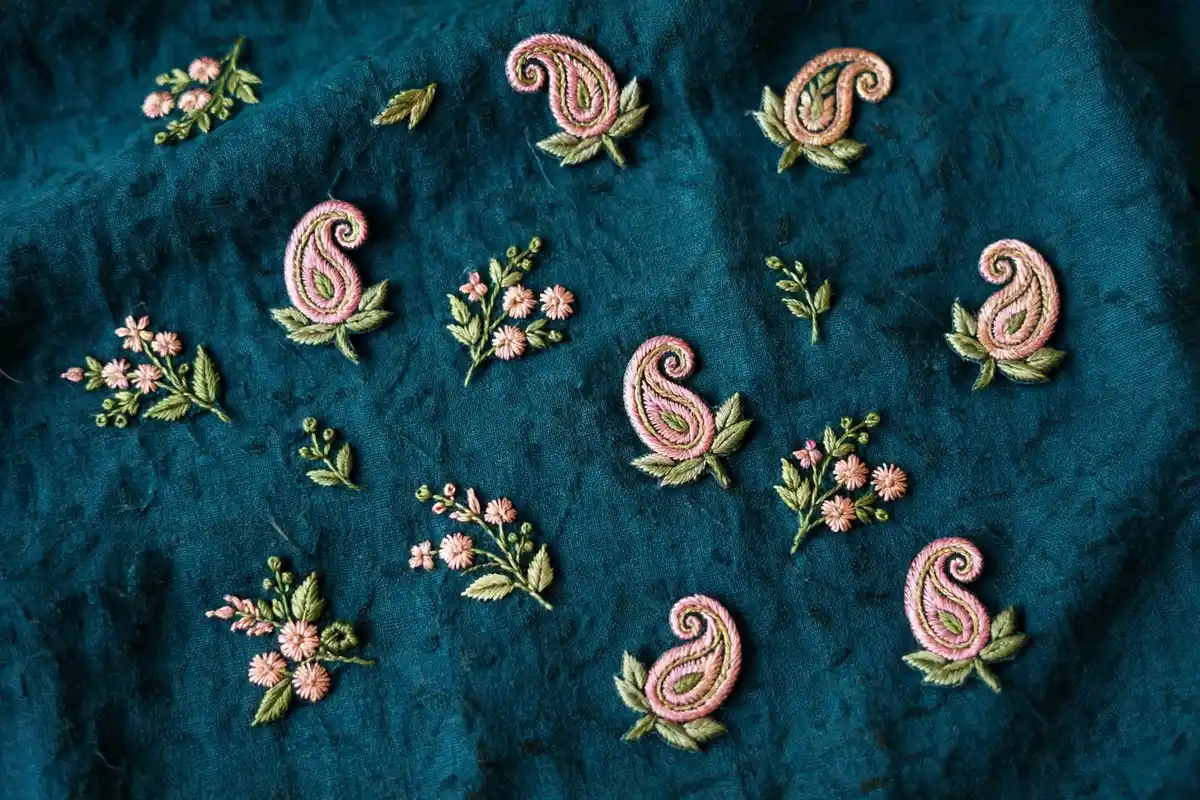
The paisley — called ambi or kairi in many workshops, the curved teardrop with the bent tip — is the hardest-working motif in eastern wear. It stands alone as a boota, stacks into bunches, repeats into borders and fills whole fronts in jaal patterns where motifs join into a net. We draw its outline as one flowing curve and follow that bend with the stitch direction, so the finished shape looks poured rather than stamped. Inner detail is layered with open space between levels; a paisley filled solid loses the very shape that makes it loved.
Florals follow the same care. Roses, jasmine sprays, lotus heads and simple five-petal flowers each get petal shapes that hold at small sizes. Leaves carry as much of the design as flowers do — a good leaf set gives a bunch its movement — so leaves are drawn in at least two angles and never pasted as one flipped shape down the whole spray.
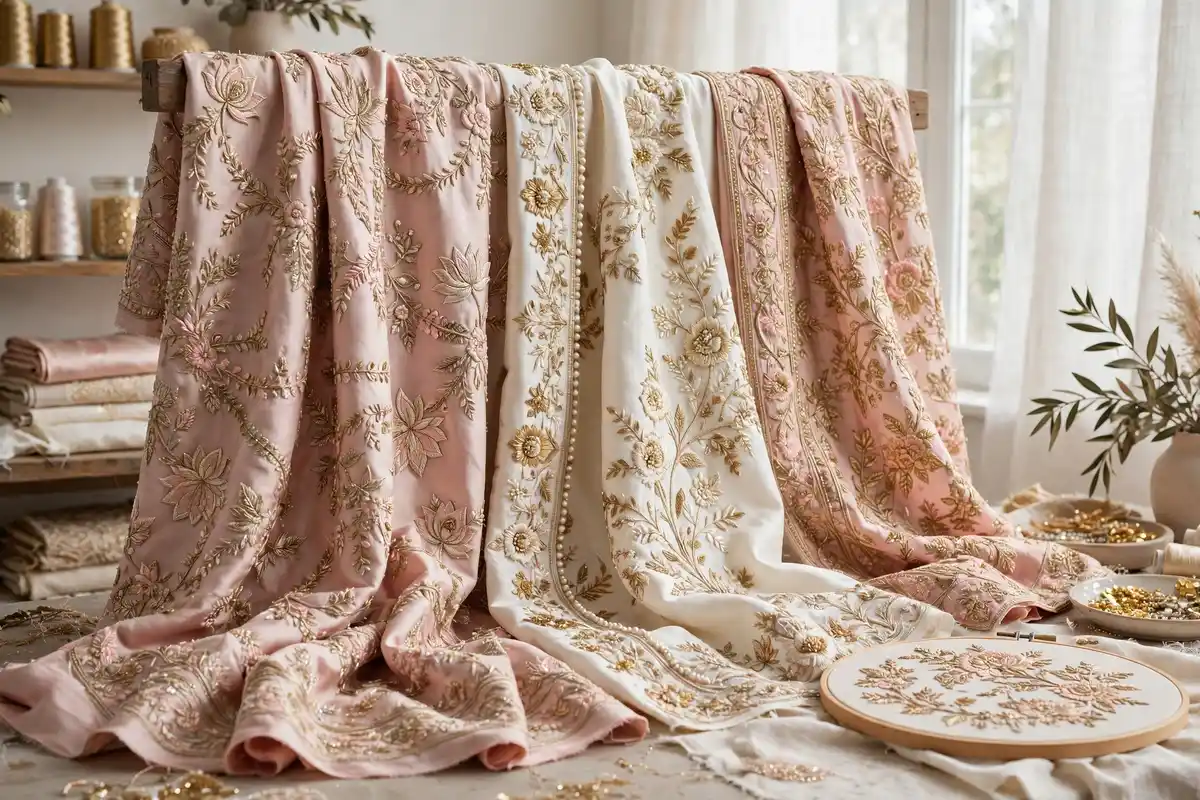
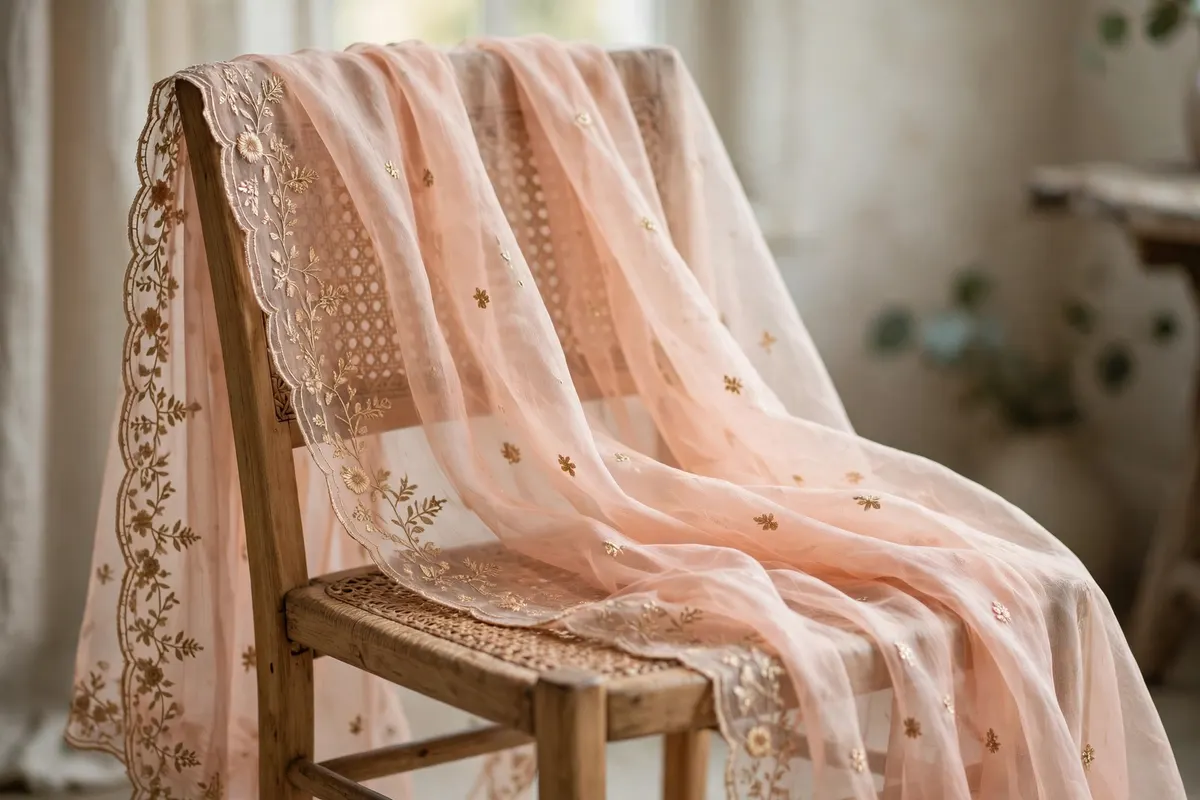
Fabric still rules the final settings. Lawn fronts take crisp small motifs well. Chiffon needs motifs opened up, with running-stitch detail in place of tight fills. Silk carries fine work beautifully but shows needle marks, so jump paths are planned to travel under shapes rather than across open cloth. Tell us the fabric for each part of the set; a sleeve on cotton and a dupatta on chiffon should not share one density, and in our sets they do not.
What you get
- Single bootas, bunches and paisleys drawn clean at your exact finished sizes
- Matching sets in two or three sizes, with small sizes redrawn simpler so detail stays clear
- Placement planned on your panel measurements — rows, scatters or jaal layouts with even spacing
- Placed front files or single motifs with a placement guide, as your team prefers
- Density set per fabric, with light open settings for chiffon and dupatta work
- Free revisions until the files run clean, in DST, PES, EXP, JEF, VP3, XXX, HUS, EMB, CND or PXF
How small is too small?
A plain answer helps planning: below about half an inch, a motif can hold an outline and one inner detail — no more. Between one and two inches, a flower can carry petals, a center and a leaf or two. Above three inches, bunches can layer stems, buds and open leaves with room to breathe. If your artwork squeezes fine detail into a tiny boota, we will show you the simplified version at quote stage and let you choose. Simple and clean always outsells detailed and clogged once the outfit is on a hanger.
From one motif to a house style
Boutiques that grow a loyal following usually grow a motif language with it. One flower, drawn well, can return season after season — scattered on a summer lawn front, bunched on a festive sleeve, worked into a winter border — and customers start to spot the label at a glance. That kind of reuse only works if the first motif is drawn clean and kept on file at honest sizes. Send us the motif you want to build on, even as a rough sketch or a photo of an old piece, and we will make it the master for the set. New pieces then grow from the master instead of drifting away from it, order by order.
Motifs also travel well across products. The same boota that scatters a dress front can center a dupatta end, mark a trouser hem or sit alone on a kurti pocket area. Diaspora brands use this often when a full outfit is too much for a customer but one embroidered piece is not. Each new placement is a small order built on proven files, so sampling stays fast and the look stays one family. Tell us where you want to take a motif next; placement and density change with the garment, even when the flower stays the same.
Color changes inside one set
A motif set earns its keep when colors change. The same bunch stitched in gold on a deep festive front, in soft pastels on a summer lawn, and in one single shade on a plain daily kurti reads as three designs while sewing from one proven file family. When you order, ask for the motif built with clear color stops between flower, leaf and stem. Clean stops let your operator swap palettes at the machine without editing the file, and they let you test a new colorway on one sleeve before the whole batch follows it.
How to order
Send your artwork or photo on WhatsApp with the sizes you need, where each motif will sit, and your fabrics. We confirm the price before work starts — motif and bunch work starts from $14 per design. Files arrive in 24 hours as standard, or in 4–8 hours on rush request. See How It Works for the full process.